15Space travel· 2026 edition
Welcome to the Spacecation
// A story from 2051
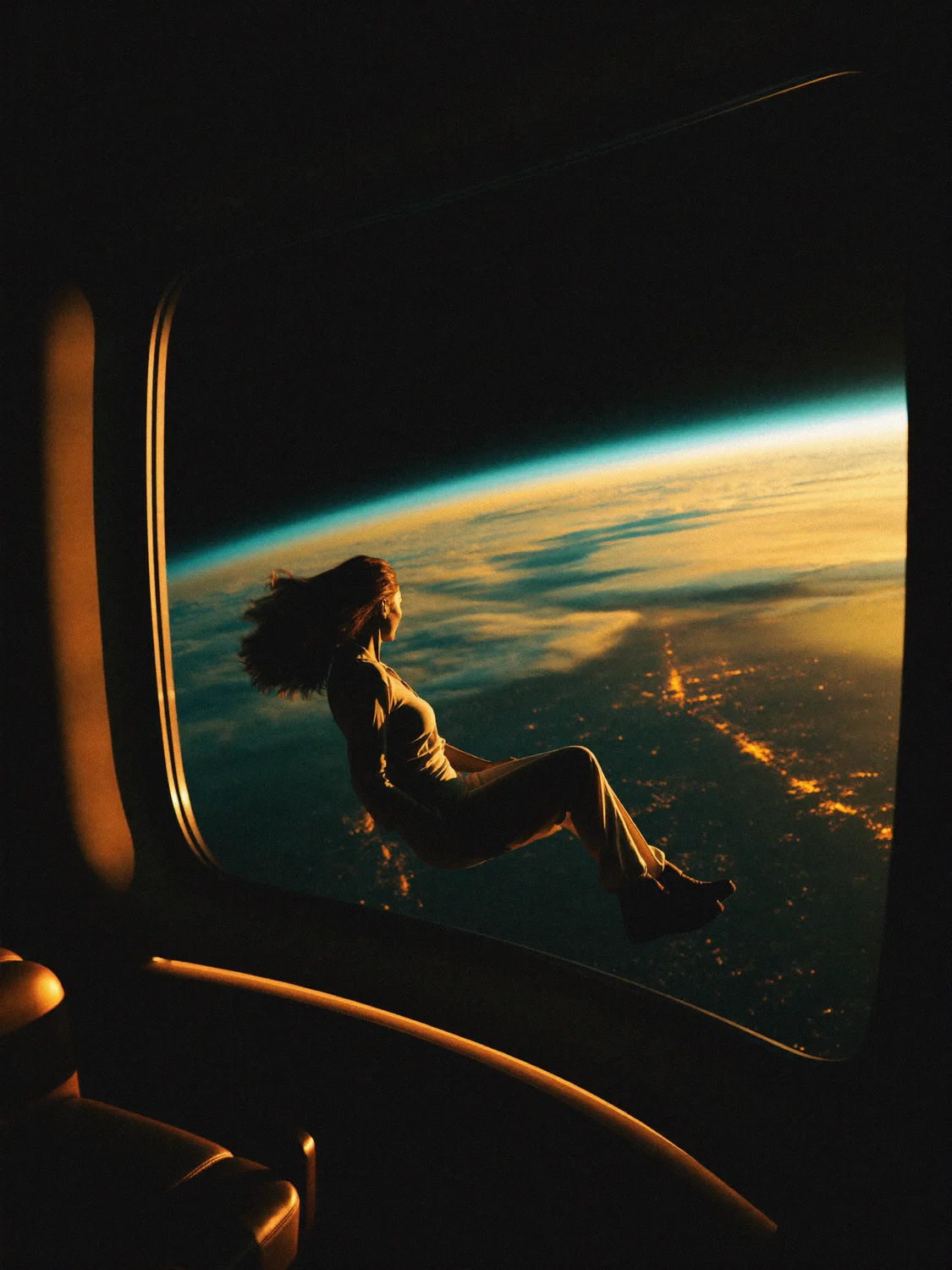
Since her holiday began, Lula hasn't missed a single sunrise. There have been forty-eight of them so far, and it is only Wednesday.
She floats by the great window of the Aldrin, a spinning wheel of a hotel turning slow circles four hundred kilometres up, and waits for the forty-ninth. The station rotates just enough to give her back a whisper of weight — enough to keep a coffee in its cup, not enough to stop her hair from drifting — and every ninety minutes the Earth's terminator sweeps beneath her and the sun detonates over the curve of the world. The tenth sunrise took her breath away. By the fiftieth she has learned what the veterans told her on the shuttle up: you never get used to it, but you do get quiet.
Her grandmother spent her retirement savings on a two-week Mediterranean cruise. Lula spent hers on this, and does not, watching the Himalayas scroll past like a diorama someone forgot to paint sad, regret it for a second. The trip cost roughly what a small apartment cost when the century began — obscene, still, but no longer unimaginable; her travel agent had a payment plan. There are two hundred guests aboard. A honeymooning couple from Lagos. A retired schoolteacher who saved for thirty years. A film crew shooting the zero-gravity ballet that everyone back home will pretend to understand. Not one of them is an astronaut. Not one of them is a billionaire. That, the schoolteacher says, is the whole miracle: we're just people, and we're in space.
Below her, on the night side, the constellations are all wrong — because they are cities. And threaded between the cities, in low slow arcs, the other lights: the factories that make fibre and drugs no gravity would allow; the fuel depot glinting like a struck match; the telescopes turned outward; the tugs hauling a captured rock toward the Moon. Space, this close in, has stopped being empty. It has started being busy — an economy with a night shift.
On the far side of the window a child, six years old, born on Earth but clearly designed by evolution for exactly this, does a slow somersault and laughs. Lula thinks: he will grow up in a century where "have you been up?" is a normal question, the way "have you flown?" was for her grandmother, the way "have you crossed the sea?" was for hers.
The forty-ninth sunrise arrives. Lula stops thinking about anything at all.
// The science behind it
The reusability revolution paid off
The 2021 edition of this chapter opened on Branson and Bezos taking their joyrides and asked, fairly, whether it was all billionaire vanity. Five years later the answer is clear, and it is the opposite of vanity: the private space age turned out to be one of the most consequential industrial revolutions of the decade, and it was built on a single boring miracle the original could only hope for — the reusable rocket actually worked, at scale, and it changed the arithmetic of everything above our heads.
The numbers still don't feel real. The cost of putting a kilogram into orbit, roughly flat for the fifty years of the government era, fell by more than an order of magnitude and keeps falling; one company came to conduct the large majority of the entire planet's launches, flying the same boosters again and again like aircraft; and the fully-reusable super-heavy vehicle now in testing — the one caught out of the sky by its own launch tower, a feat that looked like a special effect the first time — promises to drop the cost by another order of magnitude again. When the price of access to space collapses by a hundredfold in a generation, everything downstream becomes possible that wasn't. This is the master fact of the modern space age, and every other development in this chapter is its consequence. The 2021 essay called it "NewSpace" and hoped. The 2026 verdict: it delivered, harder and faster than the forecasts, which as usual undercounted.
The sky filled up
The first and largest consequence is the one overhead every night now: the satellite explosion. Cheap launch plus mass-produced satellites created the mega-constellation — tens of thousands of small spacecraft in low orbit, beaming broadband to anywhere on Earth, and the count is climbing toward a hundred thousand as competitors and nations pile in. This is a genuine revolution for the unconnected half of humanity — the internet leapfrog of chapters five and nine now arrives from orbit, to the ocean, the desert, the refugee camp and the war zone (where, notoriously, it became decisive infrastructure). It is also, and the 2021 edition barely glimpsed this, a new commons in crisis: the night sky streaked with satellite trains that astronomers say are blinding their telescopes; orbits crowding toward the nightmare of Kessler syndrome, where one collision cascades into a debris field that could wall humanity beneath its own junk. The most urgent policy frontier in space is no longer how to get there. It is traffic control, debris removal, and the governance of an orbital commons that a handful of companies and countries are filling faster than any law can follow.
Space went to work
The deeper shift is that space stopped being a destination and became an industry — infrastructure, not adventure. The 2021 essay was dazzled by the tourist; the real story is the economy quietly assembling in orbit. Earth observation matured into a nervous system for the planet: the satellites of chapter six that watch Tom's vines and the Amazon's cattle frontier, that price crop insurance and catch illegal fishing and count every ship and smokestack from space. Positioning, navigation and timing became the invisible utility all of modern life runs on. And the frontier applications the original could only imagine began to ship: manufacturing in microgravity — fibre optics of impossible purity, protein crystals for drug design, printed organs that need weightlessness to hold their shape — the first factories of an off-world economy, tiny and expensive today, following the cost curve down. The space industry did not reach the trillion-dollar forecasts by selling tickets. It got there by becoming the substrate under the terrestrial economy, and by starting, barely, to make things up there that cannot be made down here.
The tourist actually arrived
But this chapter is about the spacecation, and yes — it came, in tiers. At the top, the orbital holiday exists: private citizens have flown multi-day missions, the first all-private crews have visited the space station, and the first commercial spacewalk was performed by a paying customer, not a government astronaut. Below that, suborbital tourism — the few-minutes-of-weightlessness hop that Branson and Bezos pioneered — runs as a regular, if eye-wateringly priced, business. And the private space station is under construction to replace the ageing ISS: the commercial outposts, the inflatable habitats, and yes, the plans for the spinning, gravity-simulating hotel ring the 2021 essay adored, which remains gloriously ambitious and gloriously unbuilt.
The honest 2026 caveat is price. The spacecation is real and it is a plaything of the rich — a seat costs what a house costs, and the mass-tourism vision remains a bet on the cost curve, not a present fact. But the curve is the whole argument, and it has never once stopped bending. The 2051 forecast this book will stand behind: orbital tourism as an expensive-but-attainable experience — the round-the-world trip of its day, a once-in-a-lifetime splurge for the merely affluent rather than the merely billionaire — with the schoolteacher on Lula's shuttle as its emblem. Not everyone will go. But "people, not astronauts" is already true, and by mid-century it will be unremarkable.
The Moon, this time to stay
Beyond tourism, humanity went back to the Moon — and this chapter owes its 2021 self a note on the schedule, because the original cheerfully repeated NASA's promise of boots down by 2024. It slipped, as crewed spaceflight always slips: the return-to-the-Moon program is real, funded, and international, but running years behind its posters, its giant rocket criticised as costly and slow, its lander and spacesuits behind schedule. What is genuinely different this time is the why and the who. Apollo went to plant a flag and leave; the new program means to stay — a base at the lunar south pole, mining the water ice that hides in its permanently shadowed craters, because that ice is drinking water, breathable oxygen and rocket fuel, and fuel on the Moon changes the economics of the entire solar system. And the field is crowded now: a new space race, with a Chinese-led program targeting its own crewed landing and lunar base with a discipline that has Western agencies genuinely worried, plus robotic landers from India, Japan and private companies (some triumphant, some cratered). The Moon of 2051 is not a footprint. It is an address — contested, industrial, and permanently occupied.
The company town in orbit, and its laws
Which raises the questions the 2021 edition was too excited to ask: who owns the Moon, who governs the sky, and what happens to a person in a place with no country? The old treaties that declared space the "province of all mankind" are colliding with an era of commercial claims and national bases; new accords to govern lunar resources have been signed by some spacefaring nations and pointedly refused by others, and the fight over whether you can own what you mine from a celestial body is the property law of the century, being drafted right now with almost no public attention. Meanwhile the more immediate governance is corporate: the launch, the station, the constellation and increasingly the surveillance-and-communication backbone of civilisation are owned by a very small number of private actors, one of them wielding a personal influence over spaceflight, satellite internet and even terrestrial war that no company has held over a strategic domain in living memory. The frontier romance of space obscures a harder truth this book keeps meeting: the high ground of the twenty-first century is being homesteaded by billionaires and superpowers, and the rules for the humans who will live and work up there — their rights, their safety, their citizenship — are being written by their employers. The spacecation is a joy. The company town is a warning.
The Mars question
No chapter on space escapes the red planet, and the 2020s sharpened it from dream into a specific, funded, contested bet. One company reoriented itself entirely around Mars, building the largest rocket ever flown as an explicit Mars ship and promising crewed landings within the decade — a timeline almost nobody outside the company believes, and almost nobody inside it doubts. The gap between those two positions is the most interesting thing in spaceflight. What is no longer in doubt is that the hardware capable of reaching Mars is being built and tested now; what remains brutally unsolved is everything about surviving there — the radiation that fries a body on the year-long transit, the muscle and bone that waste in low gravity, the psychology of a crew a hundred million kilometres from rescue, the dust that ruins machines and lungs alike, and the simple, savage economics of a place where every gram of everything must be carried across the void or made from rock and sunlight on arrival.
This book takes the temperate view its whole method demands: Mars by 2051 is possible, plausibly as a small research outpost in the spirit of Antarctica — a few dozen people, heavily supported, doing science and proving it can be done — and wildly implausible as the self-sustaining city its evangelists promise, which runs into biology and economics that no cost curve erases. The deeper significance is philosophical, and the two camps are worth naming because the argument will run all century. To one, becoming multi-planetary is humanity's insurance policy and its next great purpose, the frontier that keeps a civilisation young. To the other, it is a costly distraction and a moral evasion — the fantasy that we can trash one world and decamp to another, when the hard truth is that the most hostile version of a climate-wrecked Earth is still a paradise beside the friendliest patch of Mars. This book, characteristically, holds both: go, because exploration is who we are and the science is real — but never as an excuse to stop repairing the only garden in the solar system, which no rocket in this chapter can replace.
Eyes on the deep
While humans debate the Moon and Mars, the machines went everywhere, and the golden age of robotic exploration is the quiet triumph the 2021 edition undersold. A telescope a million miles out unfolded like origami and began reading the atmospheres of planets around other stars, hunting the chemical signatures of life itself; a probe touched the Sun, flying through its outer atmosphere; rovers and helicopters roam Mars while orbiters map it; missions are en route to the ocean moons of Jupiter and Saturn, where more liquid water hides beneath the ice than exists on all of Earth, and with it the century's most electrifying open question. The search for life beyond Earth stopped being philosophy and became fieldwork — a data problem with instruments pointed at it, and a genuine chance that some morning in the coming decades a headline will end the oldest loneliness. And the economics that made it possible is this chapter's master theme once more: cheap launch and cheap electronics mean more missions, flown by more nations and universities and companies, than every previous decade combined. Space science, like space everything, was democratised by the falling price of the ride.
The orbital high ground
Finally, the shadow that falls across every hopeful paragraph above: space is a military domain now, openly and dangerously. The satellites that navigate, watch, and connect civilian life are also the eyes and nerves of modern war, and every major power has said so out loud, standing up dedicated space forces and testing the ability to blind, jam, dazzle and destroy the other side's spacecraft. Anti-satellite weapons have been demonstrated — some creating debris clouds that threaten everyone's orbits, the commons poisoned to make a point. The war in Ukraine was the first in which commercial satellite constellations were decisive and therefore targets, dragging private companies into the crossfire of a shooting war and raising a question with no precedent: what happens when a corporation owns strategic infrastructure that a superpower needs, or wants gone? The high ground has been the prize of every military revolution in history, and orbit is the highest ground there is. The most sobering forecast in this otherwise wondrous chapter is that the same access revolution putting Lula in her hotel window is arming the sky beneath her — and that the governance to prevent an orbital arms race, like the governance for everything else up there, is running far behind the rockets. The view from space, the astronauts always say, erases the borders. The tragedy the 2020s revealed is that we brought the borders with us anyway.
The road to 2051
Access keeps getting cheaper, and that changes everything. The fully-reusable heavy lifter drops the price another order of magnitude; space stops being scarce and starts being cheap, and applications no one has thought of yet become obvious — the pattern of every cost collapse in this book.
Orbit becomes industrial infrastructure — Earth-observation nervous system, manufacturing platform, energy and comms backbone — with debris and traffic control as its defining crisis and orbital governance as its defining fight.
Tourism tiers and descends. Suborbital hops, then orbital stays, then the gravity-hotel — each a rung down the cost curve, from billionaire stunt to affluent splurge to, eventually, the thing a schoolteacher saves thirty years for. "Have you been up?" becomes a normal question.
The Moon becomes a permanent, contested address — ice-mined, base-built, raced for by nations and companies — and Mars moves from fantasy to funded long-shot, the century's great open question of whether humanity becomes, or merely visits being, multi-planetary.
And the law races the rocket. Property rights on celestial bodies, the orbital commons, the citizenship of the off-world worker — the century's most consequential legal frontier, being settled by whoever gets there first. The spacecation proves we can all go. Who makes the rules when we do is the question the wonder must not be allowed to hide.
// 2021 → 2026 verdict
2021 verdict: Probability 90/100 — NewSpace, tourism, a return to the Moon. 2026 reality: the industry exceeded the forecast; the tourism and the Moon landing ran late — and space quietly became infrastructure. Reusability paid off beyond the dreams of 2021; the sky filled with satellites and their problems; the spacecation arrived for the rich and is descending the cost curve toward the rest. Lula's sunrise is coming. So is the fight over who owns the window.
This chapter was rewritten in 2026 by Brice × Claude Fable5. Read the original 2021 edition — written entirely by humans, published one year before ChatGPT existed.