03Retail· 2026 edition
The cashier is dead
// A story from 2051
The crate arrives at 6:47, eight minutes before the house wakes up. The drone doesn't land — it lowers the delivery on a whisper-quiet winch between the apple trees, scans the garden for the cat, and is gone over the hedgerow before the kettle clicks on.
Inside the crate: the week. Flour from the mill four villages over, cell-cultured duck for Sunday, printer cartridges, a replacement valve for the greenhouse, her daughter's astronomy kit, and the exact moisturiser Noor stopped buying two years ago but started needing again — her home agent noticed the winter, the humidity logs, and the way she'd been rubbing her hands in the evening video calls. She never asked. It never asked. The right thing is simply in the crate.
The agent that ordered it all lives in the utility room, between the heat pump and the water softener: a plain grey box they bought at the appliance store for the price of a dishwasher. Fully local, fully theirs. It knows the pantry to the gram, the budget to the cent, the children's allergies, the neighbours' surplus eggs, the price curves of forty suppliers. At three in the morning it had negotiated with the wholesaler's agent — two machines haggling in milliseconds over marginal cents and delivery windows — and split the order across the regional fulfilment ring: the automated depot in the old cash-and-carry, the farm co-op's robot barn, the fabrication hub that used to be a multiplex.
Noor lives forty minutes from the city and misses nothing. The city, these days, is where you go on purpose.
Which is exactly what they're doing this morning. It's her son's birthday, and he has begged for months to see the Museum of Retail. They take the tram in — past the towers where the department stores used to be, now apartments with orchards on the loading docks — and queue with tourists under the restored neon of a twentieth-century supermarket. Aisles. Trolleys. Shelf after shelf of identical products, thousands of them, just sitting there, waiting for strangers to walk past.
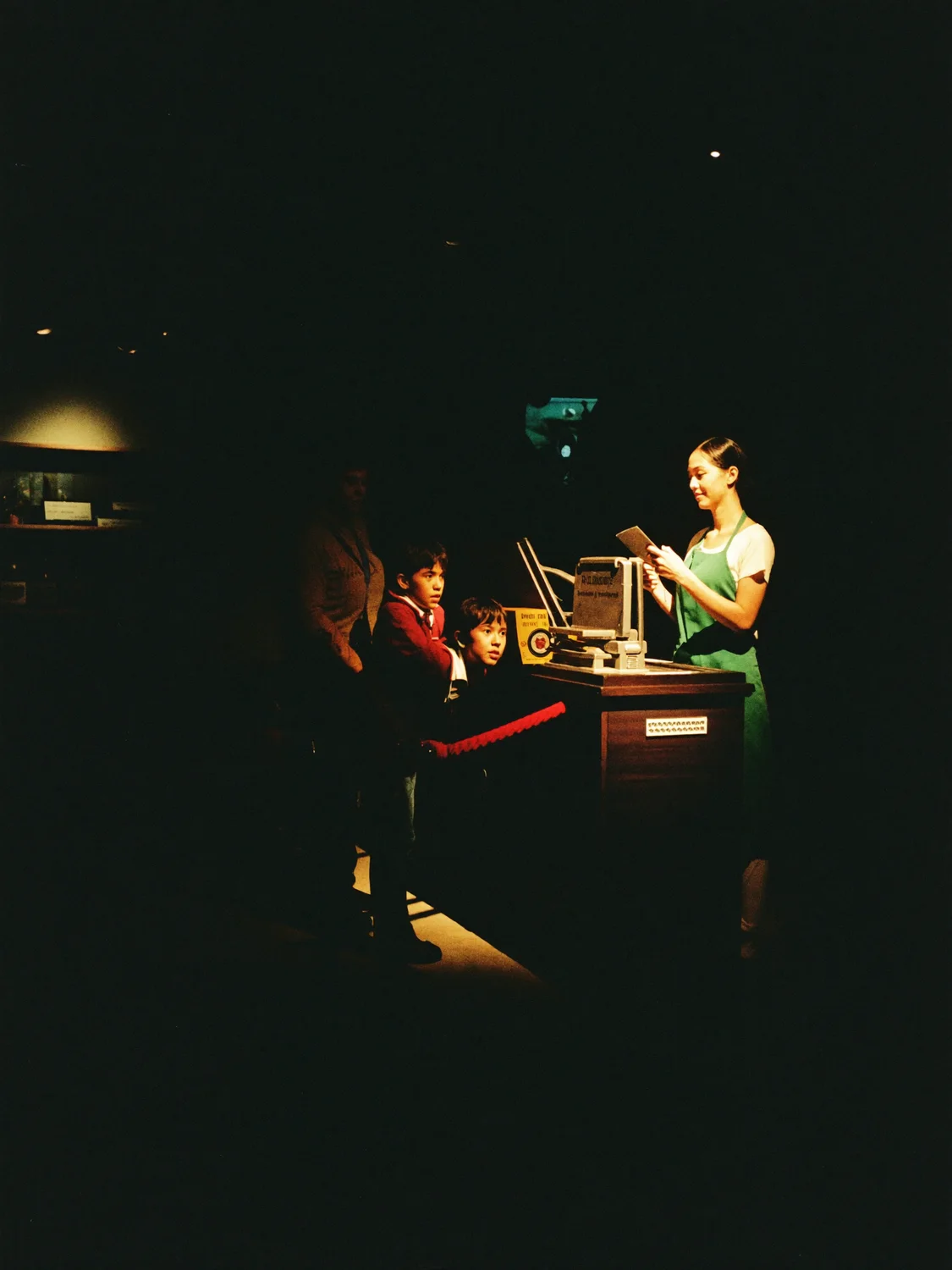
At checkout lane 3, a woman in a green apron scans their souvenirs one by one, beep by beep, and counts out change in coins. She is the museum's star performer; the plaque says she trained for the role with retired cashiers, the way blacksmiths once taught their craft to costumed apprentices.
"Did people really do this every day?" his son whispers.
"Twice a week," Noor says. "We drove there. We walked every aisle. We queued."
The boy stares at the cashier, at the conveyor belt, at the beautiful, absurd abundance.
"That's the coolest thing I've ever seen," he says.
// The science behind it
The trip that died
Every civilisation organises itself around its errands. For a century, ours was organised around the shopping trip: cities zoned around retail, roads sized for Saturday traffic, town centres defined by their shopfronts. Then, in the space of a few years, the errand started to evaporate — and the buildings are still standing there, wondering what happened.
The pandemic was the hinge. Covid didn't invent e-commerce, remote work or home delivery; it force-fed them to entire populations at once, and habits that analysts expected to take a decade formed in eighteen months. When the lockdowns ended, the reflexes stayed. Offices refilled only partway, and only some days; the Monday-to-Friday commuter — the person every downtown sandwich shop, dry cleaner and department store was built to serve — became a Tuesday-to-Thursday visitor, then a video call. Foot traffic never fully returned, and retail followed the feet. The lists grew numbingly familiar: chain bankruptcies, anchor stores going dark, high-street vacancy grinding upward, the "doom loop" of downtowns losing shops because they lost workers and losing workers because they lost everything else. The shopping trip isn't extinct in 2026 — but it has stopped being the default, and defaults are where civilisations live.
What replaced it is a logistics system wearing the costume of a habit. The store didn't disappear; it dissolved — into apps, lockers, vans, subscriptions, same-day promises. Retail stopped being a place you go and became a service that finds you. And that dissolution, barely two decades old, is about to be completed by three technologies arriving together: agents, robots, and home compute.
Your next customer is an agent
The most consequential shopper of the late 2020s doesn't have eyes. Commerce is quietly being rebuilt around software that buys on your behalf: assistants that compare, negotiate, subscribe, reorder and return, connected to payment rails designed for machine-to-machine checkout. The plumbing arrived with astonishing speed — agent-ready payment protocols from the big processors, merchant APIs exposing live inventory to bots, retailers launching "buy for me" features that treat the human as the approver of a purchase rather than its executor.
The implications cascade through everything retail spent a century learning. Marketing built for human eyeballs — end-cap displays, impulse aisles, jingles — means nothing to an agent parsing structured data. Search-engine optimisation is giving way to its successor: being legible, trustworthy and well-priced to machines. Brand loyalty mutates into protocol trust: your agent doesn't feel warmly about a detergent; it knows which supplier delivered on time, in spec, at the agreed price, every week for three years. The winners of agentic commerce will be the merchants who are boringly reliable in machine-readable ways — and the emotional brands will retreat to where emotion still shops: the experiences, the gifts, the feast.
This is also, quietly, the end of the attention-market bargain that funded the consumer internet. An agent doesn't scroll, can't be distracted, and never buys the thing next to the thing. When attention stops being the currency of commerce, an entire advertising economy has to find a new host — and the merchants know it, which is why the fastest-growing line on retail balance sheets is no longer media but logistics.
A server in every home
Here is the piece almost everyone underestimates, and the heart of this chapter's fiction: the family agent will not live in someone else's cloud. It will live in the utility room.
The economics are already converging. Consumer hardware capable of running capable local models — the descendants of today's compact AI boxes — is falling toward the price of a serious household appliance, and there is nothing exotic about the comparison: a machine that manages your provisioning, your budgets, your maintenance and your family's data deserves the same domestic status as the machine that washes your dishes. Call it what it will inevitably become: the household server, bought at the appliance store, plugged in between the heat pump and the router, replaced every ten years.
The case for local is not ideology; it is fit. A household agent must know everything — income, health quirks, children's schedules, what you actually eat versus what you claim to — and that totality is precisely what should never sit in an advertising company's datacentre. Local models answer in milliseconds, cost nothing per query, work when the network doesn't, and obey exactly one master. European privacy law, already the world's strictest, points the same direction: the household as its own data jurisdiction. The cloud will remain the reference library and the heavy lifter; but the memory — the diary of a family's life that a good agent necessarily becomes — belongs in the house, owned like a fridge, inherited like a photo album.
Once every home has one, commerce inverts. Demand stops being something retailers guess at with loyalty cards and starts being something households publish — my agent tells your agent what we need this week, under privacy terms my family controls. Advertising to humans becomes a rounding error; the real marketplace is a continuous, automated negotiation between millions of household agents and thousands of supplier agents. The supermarket's four-storey guesswork — what to stock, where to shelve it, how to tempt you — collapses into a solved problem of logistics.
Robots eat the last mile
None of this works if delivery stays expensive, and this is where the 2020s quietly crossed a threshold. The last mile — historically the most human, most expensive stretch of any supply chain — is being industrialised from both ends.
From the warehouse side: fulfilment centres now run on robot fleets numbering in the hundreds of thousands, storage systems that bring shelves to pickers and increasingly dispense with the pickers, micro-depots that pack a neighbourhood's orders in minutes. From the street side: delivery drones have gone from stunt to schedule — millions of routine flights delivering groceries, medicine and coffee in cities from Shenzhen to Dallas — while sidewalk robots trundle campus and suburb, and autonomous vans begin their slow regulatory march. Each of these was a demo in 2020 and is a line item in 2026; stitch them together and the cost of bringing a crate to a garden gate stops being a wage and becomes a watt.
The countryside, counterintuitively, is where the robots pay off first. Rural delivery was always the economic dead zone of retail — too few customers per kilometre to justify a van — which is precisely why drone networks proved themselves flying blood and medicine across roadless regions of Africa before they carried burritos across American suburbs. A drone does not care about population density; it cares about airspace and distance, and the empty sky over farmland is the cheapest logistics corridor ever discovered. The technology that cities treat as a convenience is, for the village, the end of a two-century disadvantage.
The wars and shocks of the decade accelerated the same build-out from above. Blockaded corridors, missile-priced shipping lanes and pandemic port chaos taught every government the lesson retailers learned about attention: just in time assumes a peace and a climate that no longer hold. So supply chains are being rebuilt for resilience — regional depots, redundant suppliers, nearshored production, automated everything — and the same infrastructure that hardens a nation against the next shock happens to be the infrastructure that delivers Noor's crate at 6:47. Automated distribution is becoming what road networks and power grids were to earlier centuries: not a competitive advantage but a public assumption.
The city repurposed, the countryside upgraded
Subtract the errand from the city and something remarkable happens: the city gets better at everything else. The square footage is staggering — malls, big boxes, high-street chains, department stores, and the parking that served them — and its second life is already being written: housing in the department stores, clinics and colleges in the malls, vertical farms and fulfilment hubs in the big boxes, workshops and studios where the chain stores were. Ground floors are shifting from selling to doing: care, food, culture, repair, gathering. The city of 2051 will have shops the way the city of 2026 has blacksmiths — artisanal, deliberate, wonderful, and rare. What remains of physical retail becomes theatre: flagship experiences, human advice worth travelling for, and places engineered for the one thing logistics cannot deliver, which is other people.
And the countryside gets the other half of the bargain. For two centuries, the city's decisive advantage was proximity — to goods, services, work, choice. Delivery networks, remote work and household agents dissolve that advantage crate by crate. When the drone reaches the village in the same hour as the suburb; when the specialist consults by video and the co-op's robot barn stocks the region; when your agent can summon anything the city has — then living among the apple trees stops being a retreat and becomes a plain preference. The great sorting of the twentieth century — people piling into cities to be near the stuff — begins, gently, to run in reverse. Not everyone will go; cities will thrive as places of density, culture and encounter. But for the first time since industrialisation, geography is becoming a choice about how you want to live rather than what you need to reach.
Trust, fraud, and the burglar's new toolkit
Hand your provisioning to software and you inherit software's oldest problem: it can be lied to. The scams of the agentic era are already recognisable in embryo — merchants poisoning product data to seduce shopping bots the way they once gamed search engines; counterfeit suppliers with immaculate machine-readable storefronts; prompt-injected reviews whispering instructions to the assistant instead of the human; and the nightmare scenario every security researcher demos at conferences: the compromised household server, a burglar who lives in your utility room and knows your gram-level pantry, your travel dates, your children's school run.
So a new trust industry is assembling, rhyming with the one that made credit cards survivable. Agent identity — cryptographic proof of whose agent is asking — is becoming the handshake of commerce; payment rails enforce mandates and spending limits the way chip-and-PIN once replaced signatures; independent auditors certify household models the way engineers certify boilers, and insurers price the difference. Families will learn agent hygiene as they once learned not to email their PIN — and the household server's yearly inspection will feel as normal as the heat pump's. None of this is a reason the future doesn't happen. It is the reason it takes a decade longer than the demos suggest, and arrives boring — which is how infrastructure is supposed to arrive.
What the aisles were secretly for
Honesty requires an accounting of what dissolves along with the store. Retail was the largest employer in most developed economies — the first job of millions of teenagers, the second act of millions of careers. Checkout automation, dark warehouses and delivery robots unwind that employment engine faster than new sectors absorb it, and the transition politics of the 2030s will be shaped by it: the cashiers, drivers and shelf-stackers of the old economy retraining into the care, craft and experience work the new one actually values — with all the friction, and all the government programs, that sentence implies.
And something subtler goes with them. The aisles were never just logistics; they were one of the last places a whole society physically mingled by accident. The supermarket queue was where you saw your neighbours, ran into your ex, noticed a product you weren't looking for, taught your child to wait its turn among strangers. Serendipity, browsing, the unplanned encounter — these were bundled free with the groceries, and unbundling them leaves a hole the crate at the gate cannot fill. The optimistic bet, visible in every thriving market hall and every packed weekend fair of 2026, is that we will rebuild those functions on purpose: gathering places designed for gathering, commerce as the excuse rather than the point. The pessimistic bet is a society that never leaves the garden. Both futures are compatible with the logistics; the choice between them is not technical at all.
The road to 2051
Distribution becomes a utility. Like water and power, the crate at the gate stops being a market of promises and becomes infrastructure — automated, regional, resilient by law, boring by design.
Every household runs its own agent, on its own hardware. Bought where you buy appliances, priced like a dishwasher, private like a diary. Family demand is published, negotiated and fulfilled machine-to-machine; nobody "does the shopping" any more than they draw water from a well.
Retail bifurcates into logistics and theatre. The provisioning half disappears into the walls of the economy; the experiential half — markets, flagships, feasts, fairs — flourishes precisely because it no longer has to move the groceries.
Cities shed their retail skeleton and grow a new one around care, culture, craft and encounter; the countryside gains city-grade access without the city. The commute, the errand and the aisle all become stories we tell our children —
— in a museum, at checkout lane 3, where the last cashier counts out change, beep by beep, for the most attentive audience she has ever had.
// 2021 → 2026 verdict
2021 verdict: Probability 97/100 — for the automated megamarket. 2026 reality: righter than intended. The checkout did die — but so, quietly, did the trip to it. The store isn't being automated. It's being dissolved — and the cashier's second act is on a stage.
This chapter was rewritten in 2026 by Brice × Claude Fable5. Read the original 2021 edition — written entirely by humans, published one year before ChatGPT existed.