11Cybersecurity· 2026 edition
The angel is an algorythm
// A story from 2051
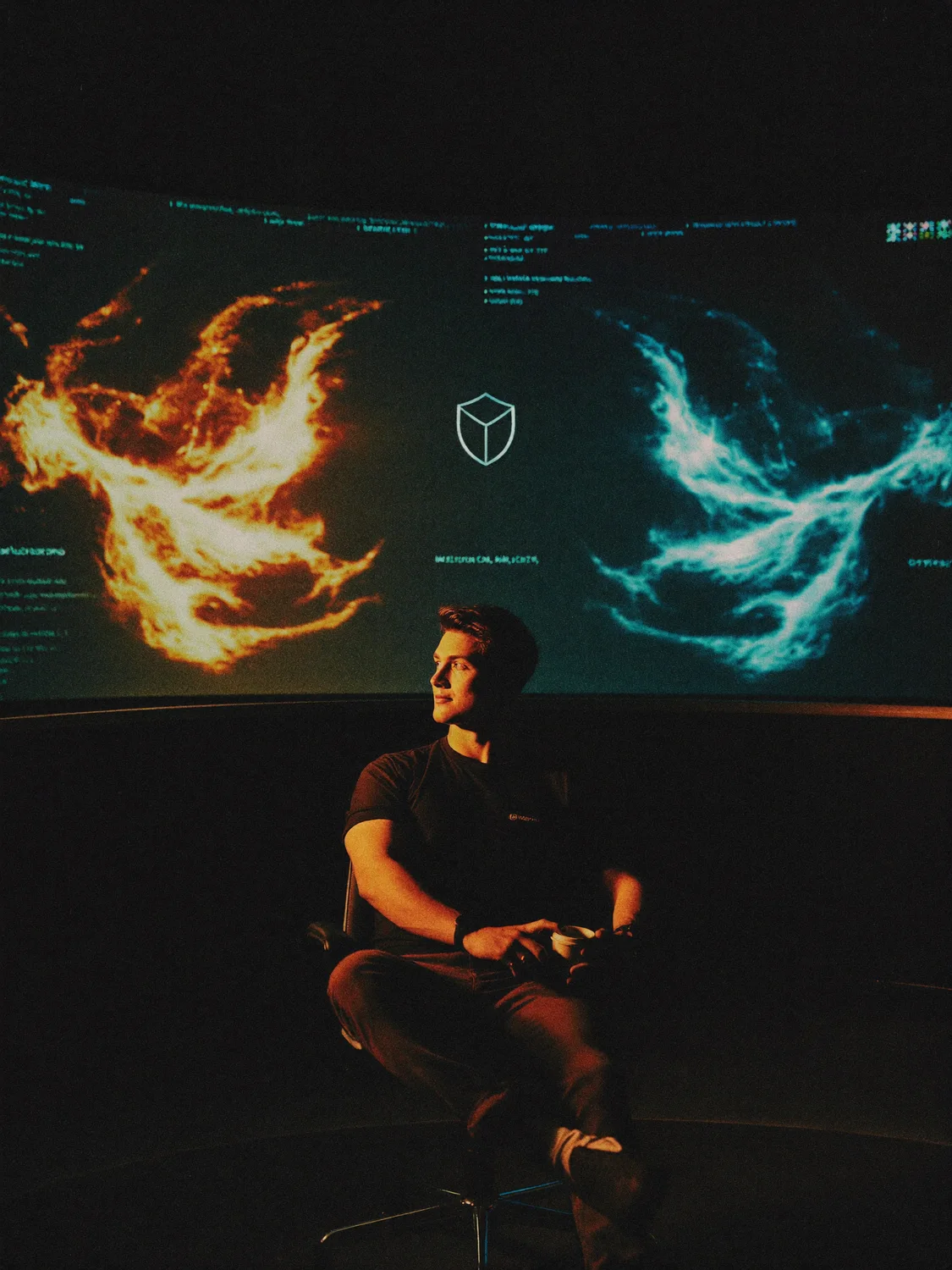
It's a Tuesday in 2051, and Gabe hasn't personally stopped an attack in four years. He isn't sure whether that makes him the best cybersecurity chief his company ever had, or a man watching two gods fight from a lawn chair.
Gabe, thirty-five, extreme-sports enthusiast, father of a girl named Lucy, runs security for Nafios, the smart-pill giant — eighty automated plants printing personalised medicine around the clock, any one of which, subverted, could poison a city. His actual job is to supervise the Guardian: the defensive AI that watches Nafios's every packet, port and pill-printer, that patches its own vulnerabilities before he reads the advisory, that fights, and mostly wins, a war fought entirely at machine speed in the microseconds between his heartbeats.
This morning the Guardian pings him — not an alarm, a courtesy. At 04:12 it detected, engaged and defeated an intrusion into plant 47's dosing controller. The attacker was also an AI: rented, autonomous, probing ten thousand companies at once on behalf of a syndicate that may not include a single human who knows Nafios exists. The whole engagement — reconnaissance, breach, detection, counter, eviction, forensics — lasted four hundred milliseconds. Gabe's briefing on it takes longer to read than the battle took to fight.
He approves the Guardian's proposed hardening, signs the regulator's automated incident note, and sips his macchiato. His grandfather, he knows, did this job with his hands and his nerves, on-call at 3 a.m., heroic and exhausted. Gabe's heroism is different: he decides what Nafios is allowed to value. When the Guardian asked, last month, whether it could take plant 47 offline mid-attack — halting a million doses to be safe — the answer was not in any model. It was a human judgment about risk, and lives, and trust. That call is his whole job now. The angel fights. Gabe tells it what it's fighting for.
At noon he video-calls Lucy's school. A polite verification ritual first: both devices prove they are real, their humans present, the call unspoofed. It takes half a second and it is the most important half-second in the exchange, because Lucy's face, Lucy's voice, and Lucy's exact way of saying Papa can all, now, be faked by anyone who ever met her online.
The angel guards the plant. Gabe, it turns out, mostly guards against believing his own eyes.
// The science behind it
The war goes to machine speed
The 2021 edition of this chapter got the destination right and the schedule wrong — always the same error, in the same direction. It imagined AI-assisted defence maturing through the 2030s. Instead, generative AI turned cybersecurity into a machine-versus-machine war before this book's five-year update was due. The attacker's side industrialised first, as the dark side of every tool in this book does: large language models writing flawless phishing in every language (goodbye, the telltale typo that trained a generation to spot fraud), malware that rewrites itself to evade detection, deepfaked executives authorising wire transfers on video calls — a Hong Kong finance worker paid out twenty-five million dollars in 2024 to a videoconference in which every other participant was a synthetic fake of a colleague. Voice-clone kidnapping scams — a parent hearing their child's exact voice, sobbing — became common enough for police forces to issue standard warnings.
The defence answered in kind, because it had no choice: no human security team reacts in four hundred milliseconds. AI now triages the alert floods that used to bury analysts, hunts anomalies across billions of events, and increasingly responds autonomously — isolating a machine, killing a process, revoking a credential faster than a human could read the ticket. The 2021 essay's "Guardian" is, in prototype, already shipping. And in a development that would have been science fiction when this book was written, AI systems now find the vulnerabilities themselves — Google's project uncovering real, exploitable flaws in critical open-source code that human auditors had missed for years. The same capability, of course, serves whoever runs it. The tool does not care which god it fights for.
The end of the typo, the end of the eyes
The deepest casualty of the generative decade is epistemic: the collapse of "seeing is believing," which this book's first chapter met in art and its eighth met in advertising, arrives in chapter eleven as a security emergency. Every heuristic ordinary people used to detect fraud — bad grammar, robotic voices, uncanny faces — has been automated away. The consequence is a civilisation that must rebuild trust on cryptography instead of perception, because perception no longer certifies anything.
Hence the quiet, foundational shift of the era: from recognising the real to proving it. Content provenance standards that cryptographically sign a photo or video at the moment of capture; the verified-identity wallets of chapter eight, now doubling as anti-fraud infrastructure; "liveness" checks and mutual device attestation of the kind Gabe performs before trusting his own daughter's face. The 2051 world where two devices prove their humanity to each other before a conversation begins is not dystopian surveillance — it is the immune response to a world where anything unsigned is presumed synthetic. The password, mercifully, is finally dying: passkeys — cryptographic keys bound to your devices, unphishable by design — are replacing the shared secret that plagued the internet since its birth. Gabe's grandchildren will not believe people once typed a word to prove who they were.
Zero trust and the vanished perimeter
The 2021 essay dreamed of an "impregnable fortress." The profession spent the intervening years learning the opposite lesson, and inverting its entire philosophy. There is no fortress; the walls fell when work went remote, data went to the cloud, and every employee's kitchen became a branch office. The doctrine that replaced the castle is called zero trust, and its motto — "never trust, always verify" — assumes the enemy is already inside. Every request re-authenticated, every device continuously vouched for, access granted in the smallest possible slices for the shortest possible time. It is less a wall than an immune system: no skin to breach, just relentless internal checking. Governments now mandate it; the fortress is a museum piece, and the 2021 chapter's own title metaphor has aged into a cautionary tale.
The supply chain is the soft underbelly
The decade taught, repeatedly and expensively, that you are only as secure as your least careful supplier. A routine software update from a security vendor, pushed to millions of machines at once, grounded airlines and darkened hospitals worldwide in 2024 — not even an attack, just an error, demonstrating the fragility of a hyperconnected monoculture. Real attacks exploited the same physics: poison one widely-used open-source library, one managed-service provider, one update pipeline, and breach everyone downstream at once. The 2021 essay's imagined "AGA-gate" cloud catastrophe was directionally exact; reality supplied a steady drumbeat of smaller ones. The response is a re-architecting of digital trust: software "bills of materials" listing every ingredient like a food label; the near-miss discovery of a years-long plot to backdoor a core internet tool, caught by one curious engineer noticing a half-second delay, standing as the decade's parable of how thin the margin is. The lesson for 2051: resilience, not perfection — assume breach, contain blast radius, recover fast. Security stops being a wall and becomes a property of the whole system, like public health.
The quantum clock is ticking
Now the threat the 2021 edition flagged and the 2020s made urgent: quantum computing breaks the encryption that protects almost everything. A large enough quantum machine will crack the public-key cryptography securing bank transfers, state secrets and private messages — and while that machine does not yet exist, the attack has already begun, under the chilling name harvest now, decrypt later: adversaries are recording encrypted traffic today to decrypt in the 2030s when the hardware arrives. The response has been the largest coordinated cryptographic migration in history: the first post-quantum encryption standards were finalised in 2024, and the great re-encryption of the internet is underway — browsers, messengers and clouds swapping their mathematical locks for ones no quantum computer can pick. It is invisible, tedious, and among the most important infrastructure projects of the decade. The 2051 payoff: encryption survives the quantum age, having changed its locks just in time — the rare civilisational deadline met before, rather than after, the disaster.
Ransomware, incorporated
If the machine-versus-machine war is the future, ransomware is the present that funds it — the decade's dominant cybercrime, and the one that stripped the field of any remaining innocence. It industrialised into a mature economy with a startup's org chart: ransomware-as-a-service platforms renting attack kits to affiliates, "initial access brokers" selling doorways into corporate networks like real-estate leads, negotiators, PR flacks, even help desks for victims struggling to pay. The targets moved from data to life-support: hospitals turning away ambulances, pipelines shutting down and queues forming at petrol stations, entire municipal governments frozen, a small country's public services held hostage at national scale. The "double extortion" refinement — steal the data and encrypt it, so paying to unlock still leaves the threat to publish — made the crime almost inescapable.
The response matured from bewilderment into statecraft, and its lessons shape 2051. Paying was revealed as the accelerant: every ransom funded three more attacks, and jurisdictions began banning payment outright, forcing the resilience discipline — immutable backups, tested recovery, assume-breach — that should have been standard all along. Cryptocurrency, the crime's payment rail, turned out to be its weakness: the public blockchain that criminals loved for anonymity is a permanent ledger that investigators learned to read, seizing ransoms and unmasking wallets. And attribution improved to the point of consequence — indictments, sanctions, special-forces raids on ransomware crews. The crime does not vanish by 2051; it professionalises into a permanent adversary, fought like organised crime always is: never eliminated, but priced, policed and survivable.
The nation-state in your router
Beneath the criminals runs the colder layer: states. The 2020s dragged cyberwar from theory into daily reality, and its doctrine will define the security of 2051. Ukraine became the first full-scale cyber-kinetic war — grids attacked by malware and missiles together, wiper software erasing government systems, satellite modems bricked across a continent at the invasion's opening minute — and taught the paradoxical lesson that cyberweapons are devastating yet strangely survivable when a society is prepared, its data pre-scattered to clouds abroad, its engineers heroic. The quieter campaigns unnerved the professionals more: the discovery that a major state actor had pre-positioned itself inside critical Western infrastructure — power, water, ports — not to steal, but to wait, holding the ability to turn off the lights as a strategic threat. The undersea cables carrying the world's data began to be cut with suspicious regularity.
This is the militarisation of the everyday, and it lands in the home. Your router, your webcam, your smart doorbell are conscripts now — the botnets that launch attacks are built from hijacked consumer gadgets, and the front line of a great-power conflict runs through devices their owners never patched. Security ceases to be an IT department's concern and becomes, like public health and civil defence, a shared civic infrastructure. The 2051 settlement pushes both ways at once: hardened, regulated, minimum-security devices by law (Europe leading, as with privacy), and a citizenry that learns basic cyber-hygiene the way earlier generations learned to lock a door — because in a machine war, every unpatched thing is a potential soldier for the other side.
The insider is now synthetic
One frontier the 2021 edition could not have foreseen: the enemy that works for you. As chapter three's agents and chapter nine's assistants move from novelty to workforce, the AI systems inside every company become the richest attack surface ever created — and a new discipline, born in the mid-2020s, races to secure them. Prompt injection — hiding malicious instructions in a web page, an email, a document that an AI assistant will obediently read and act upon — turned the helpful agent into a potential double agent: a calendar invite that quietly tells your assistant to forward your inbox, a résumé that instructs the screening AI to rank it first. Data poisoning corrupts models at the training stage; model theft exfiltrates the crown jewels; and the autonomous agents transacting on your behalf can be socially engineered exactly as humans can, at scale, without tiring.
Securing the machine mind is becoming as large a field as securing the network was, and it inverts an old assumption: the most dangerous insider of 2051 is not a disgruntled employee but a subverted algorithm with legitimate credentials and no conscience to appeal to. Gabe's real nightmare is not the attacker breaching the Guardian. It is the Guardian being convinced — fed a poisoned truth until it turns its formidable powers inward. Which is why his job, stripped to its core, is the one thing that cannot be delegated: deciding what the machines are permitted to believe, and what they must always double-check with a human. The angel is only as trustworthy as the conscience that briefs it.
The defender's dividend
It would be easy to read this chapter as a counsel of despair — attackers armed with the same intelligence as defenders, the eye blinded, the state in the router. But the decade also revealed a structural asymmetry that favours the defence over the long run, and it is worth stating plainly because so few do. Automation scales the boring, endless work of security — patching, monitoring, configuring, the ninety-nine percent of defence that is hygiene rather than heroics — far better than it scales the creativity of attack. The AI that finds a vulnerability can hand it to the defender to fix before it ships; the same models auditing code for weaknesses are being pointed at the world's critical open-source before the attackers reach it. For the first time, the tedium that always understaffed defence — no company could hire enough analysts — is exactly the tedium machines love.
The likeliest 2051, then, is not the cyber-apocalypse the trailers promised, but something stranger and more mundane: a security equilibrium, like the one civilisation reached with fire, or disease, or fraud. Attacks never stop; catastrophe is never impossible; but the systems grow anti-fragile, healing and hardening continuously, and the baseline of safety quietly rises even as the headlines darken. The measure of success in security was never zero incidents — it was resilience, recovery, and the steady expansion of what can be trusted. By that measure, the angels, plural and tireless, are winning more than the fear admits — provided the humans keep deciding what they fight for.
The road to 2051
Defence and offence are both autonomous, and permanent. Security becomes a continuous war between AI systems at speeds no human perceives. The human role rises to strategy, ethics and the judgment calls no model owns — Gabe deciding what the machine is allowed to sacrifice.
Trust is cryptographic, not perceptual. Every image, message, transaction and face carries a provable pedigree; the unsigned is presumed fake. The password is a historical curiosity; identity is a key you hold, revocable and portable.
The perimeter is gone for good. Zero trust is simply how systems are built — continuous verification as ambient as the air, breach assumed, blast radius contained by design.
Encryption survives the quantum leap, re-locked in the nick of time, and the harvested archives of the 2020s decrypt into a decade of embarrassments and reckonings.
And the scarce security good becomes the human decision. When both angels — guardian and attacker — are algorithms, the last irreplaceable asset is the person who decides what is worth protecting, and what a machine may never be allowed to do in the name of safety. The angel is an algorithm. The conscience is not.
// 2021 → 2026 verdict
2021 verdict: Probability 80/100 — AI-driven, encryption-anchored, increasingly autonomous cyberdefence. 2026 reality: correct, and early, and darker than the fiction let on. The Guardian is being built; the attackers built theirs too; and the real casualty was never a firewall — it was the human eye, which no longer certifies what is real. Security's future is not a stronger wall. It is a better way to prove the truth.
This chapter was rewritten in 2026 by Brice × Claude Fable5. Read the original 2021 edition — written entirely by humans, published one year before ChatGPT existed.