26Memory· 2026 edition
My body, the hard drive
// A story from 2051
It's a big day for Cassandra, a gastronomic engineer from Helsinki, presenting a new recipe — a jellyfish and pea-milk cheese sausage — to a global fast-food chain. Jellyfish, thriving on the warming, polluted seas, have been choking the ocean and delighting gastronomists; in a mostly meat-free world, Cassandra hopes her oozing neon-green creation will take the junk-food world by storm. She worked deep into the night, styling plates, filming slow-motion footage of the melting pea cheese — the mouth-watering clincher. Now she only has to carry the idea, safely, on her twelve-hour hydrogen-electric flight to New York, where IP cybercriminals working for competitors would love to steal it.
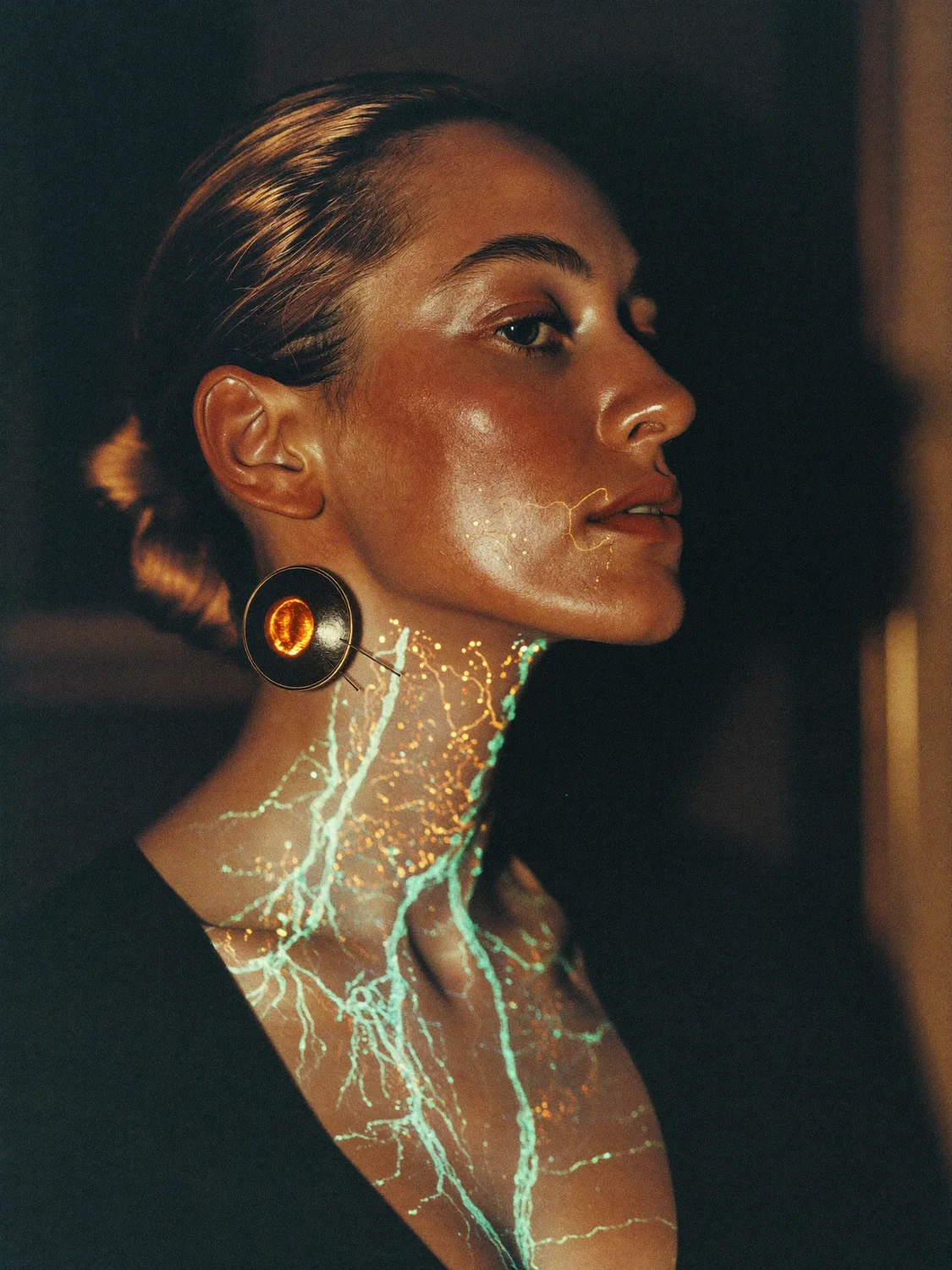
So she plugs a small device into her camera, presses its circular sensor to her neck, and feels the painless prick of tiny needles. Sipping mushroom coffee, she watches her files transfer into her bloodstream and encode, directly, into her DNA. Thirty minutes, and her designs are encrypted inside her own cells — carried by the one vessel no hacker can reach without her body in the room. At the airport an iris scan reads her passport, her travel record, her medical history, all stored inside her; her latest booster against COVID-37 sits in a subcutaneous pellet under her skin, good for five years.
On the plane she uses a neck patch to pull some childhood photos onto her tablet — she wants to revisit her old haunts, and is hunting an address from when she was eight. Over Newfoundland the tablet pings: there it is. A blazing summer day in Cobble Hill, Brooklyn; Cassandra, small and grinning, biting into a hot dog, juices running down her cheeks. A perfect moment of meat-eating happiness, from a child who could not know that by 2050 Cobble Hill would be permanently underwater — a drowned neighbourhood, still swimming with memory. She keeps the photo a moment, this data made flesh, carried in her blood over a coastline the sea has redrawn, and thinks: everything I am is inside me now, and even so, I cannot keep the places I loved from going under. The body remembers what the map forgot.
// The science behind it
The data apocalypse stopped being hypothetical
The 2021 edition built this chapter on a fear it rated at 60/100: that humanity is generating data so fast, and disposing of so little, that we are heading for a storage and fragility crisis — a "data apocalypse" — that would eventually force us to store information in radically new ways, including, eventually, in our own bodies. Five years on, the fear half of that prediction has only sharpened, while the solution half went somewhere the original did not expect. The data deluge is worse than forecast: the generative-AI explosion of this whole book turned out to be a data explosion too — models trained on oceans of it, and generating oceans more — and the world's appetite for storage, and the electricity and water the data centres consume, became a genuine strategic and environmental concern. The essay's core anxiety was right. We are drowning in our own information, and the tide is rising.
The cloud proved as fragile as the essay feared
The original's most vivid warning was about fragility — it imagined a disaster taking the cloud down for days and waking the world to its dependence. The decade delivered the rehearsal. A single flawed software update cascaded into a global technology outage that grounded flights, froze hospitals and banks, and darkened screens across the planet for a day — a stark, worldwide demonstration that our civilisation runs on a small number of fragile, centralised digital systems, and that when one hiccups, everything stops. Ransomware crippled hospitals and pipelines; cloud regions failed and took thousands of services with them. The essay's fear that we had built our entire lives on something that could blink out was vindicated not by a tsunami but by a bad patch — which is, if anything, more sobering. The vulnerability is real. What the decade got "wrong," relative to the fiction, is the response: the world did not retreat from the cloud into the body. It doubled down on the cloud, and simply tried to make it more redundant. Centralisation won; the fix for fragile centralisation was, mostly, more centralisation done more carefully.
DNA storage is real — and still in the lab, not the bloodstream
The chapter's headline technology, though, is genuinely advancing, and deserves its due. Storing digital data in synthesised DNA — nature's ultra-dense, ultra-stable medium, a single gram theoretically holding hundreds of thousands of gigabytes and lasting millennia — moved from curiosity to a serious field with a real industry and an international alliance behind it. Researchers have encoded books, images, and video into DNA and read them back reliably; the encoding and decoding the original described is solid science; companies race to make it commercially viable. And in living systems, the frontier the essay flagged advanced too: scientists have used the CRISPR tools of chapter twenty-two to write data into the DNA of living bacteria and recover it generations later, and built cellular "molecular recorders" that log events inside living cells. DNA as a data medium is no longer speculative. It is early-stage real.
But the honest 2026 verdict is the one the original itself half-anticipated: DNA storage remains archival — slow, expensive to write and read, brilliant for "cold data" you want to preserve for a century and terrible for anything you need this second. It lives in laboratories and pilot facilities, not in Cassandra's neck. The leap from "encode Wikipedia into a vial of synthesised DNA in a lab" to "transfer your files into your own living bloodstream over mushroom coffee" is not an engineering step; it is a canyon, involving biology, safety, and speed problems that are nowhere near solved. The chapter's science is arriving. The chapter's scene — the body as a personal hard drive you write to at will — remains firmly, and probably wisely, fiction.
The instinct was right, even if the mechanism isn't
Yet strip away the specific technology and the chapter's underlying instinct looks prophetic. The desire it captured — to physically own your most sensitive data, to hold your identity and your secrets in something only you possess, safe from the breaches and outages and surveillance of the cloud — has become one of the defining anxieties of the age. The decade's parade of data breaches, its ransomware epidemics, its surveillance revelations, and its growing unease about handing our entire lives to a handful of corporations gave the "keep it in your body" fantasy real emotional logic. And the mechanisms that did advance point the same direction, if by a different road: implantable chips that some already use to carry keys and payment data; biometric identity that turns your iris and face into your credentials (chapters eight and sixteen); digital wallets meant to give you custody of your own documents; the cryptographic "self-sovereign identity" movement trying to wrest personal data back from the platforms. The body did not literally become the hard drive. But the wish behind the fiction — to make identity and data something you carry and control rather than something rented from the cloud — is a live, growing project, pursued with silicon and cryptography rather than DNA.
What the body remembers
There is a quieter truth in this chapter that no storage technology touches, and the fiction ends on it with real grace. Cassandra can encode her recipe into her cells and read her whole history from an iris scan, but the photo that stops her is of a place the sea has swallowed — a perfect childhood moment in a neighbourhood that no longer exists above water. The chapter is nominally about where we put our data; its emotional core is about memory, and the ache of a technological civilisation that can preserve every file forever and still cannot preserve the world those files remember. This is the deepest register of the whole Fiction block: as we gain god-like power to store and copy and carry information, the things information is about — a coastline, a climate, a way of eating, a childhood home — keep slipping away. We will, one day, store staggering amounts of data in staggering new ways; DNA and glass and molecules will hold our civilisation's memory against any apocalypse. But the most important thing this chapter says is that a perfect archive of a drowned world is still a drowned world. The body may yet become the hard drive. It cannot become the map back to what we lost.
// 2021 → 2026 verdict
2021 verdict: Probability 60/100 — we store our most private data in our own bodies via DNA, escaping the fragile, hackable cloud. 2026 reality: the fear vindicated, the mechanism still fiction, the instinct dead-on. The data apocalypse got more plausible, not less — AI turned the data deluge into a flood, and a single botched update proved the cloud as fragile as the essay feared by freezing the planet for a day. DNA storage became a genuine, advancing field, with data written into synthesised strands and even living bacteria — but it remains slow, costly, archival, and firmly in the lab, nowhere near Cassandra's bloodstream. What the decade confirmed most is the wish: after years of breaches and surveillance, the desire to physically own your identity and data is real and growing — pursued, for now, through implants, biometrics and cryptography rather than DNA. The body isn't the hard drive yet. But a civilisation that can archive everything, and still watches the places it loved go under, is exactly the one the fiction saw coming.
This chapter was rewritten in 2026 by Brice × Claude Fable5. Read the original 2021 edition — written entirely by humans, published one year before ChatGPT existed.