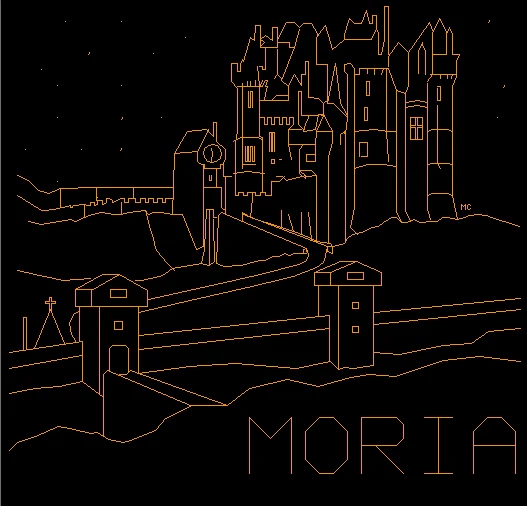
Moria, the kind of networked game that ran on PLATO.
1980 — 1988 · The geek is born
The boy who logged in.
It started in 1980, at thirteen, when the Athénée Adolphe Max in Brussels joined a pilot e-learning programme built on Control Data's PLATO terminals. The screens drew vectors, not pixels, and they were online — connected to network games like Moria and Dogfight played simultaneously across Europe and the United States. For a curious kid, it was a portal.
My first hack came soon after: a little program that mimicked the login screen and quietly collected the passwords of everyone who used it. It eventually handed me the accounts of teachers and system engineers alike. I wasn't being malicious — I was being thirteen, and irresistibly curious.
In 1982, on a school trip to London, I spent all my food money on a Sinclair ZX81. I wired it to an old TV in the attic and taught myself BASIC, coding Breakout and Pong deep into the night — until my father cut the fuses to force me to sleep. A ZX Spectrum and Z80 assembler followed; I built a Connect Four with colours and sound. Along the way I picked up Fortran, Pascal, Prolog and LISP, wrote a library system on a CP/M machine, and sold my first piece of software: an armoury manager built in dBase and FoxPro.
The screens drew vectors, not pixels. I never really logged off.
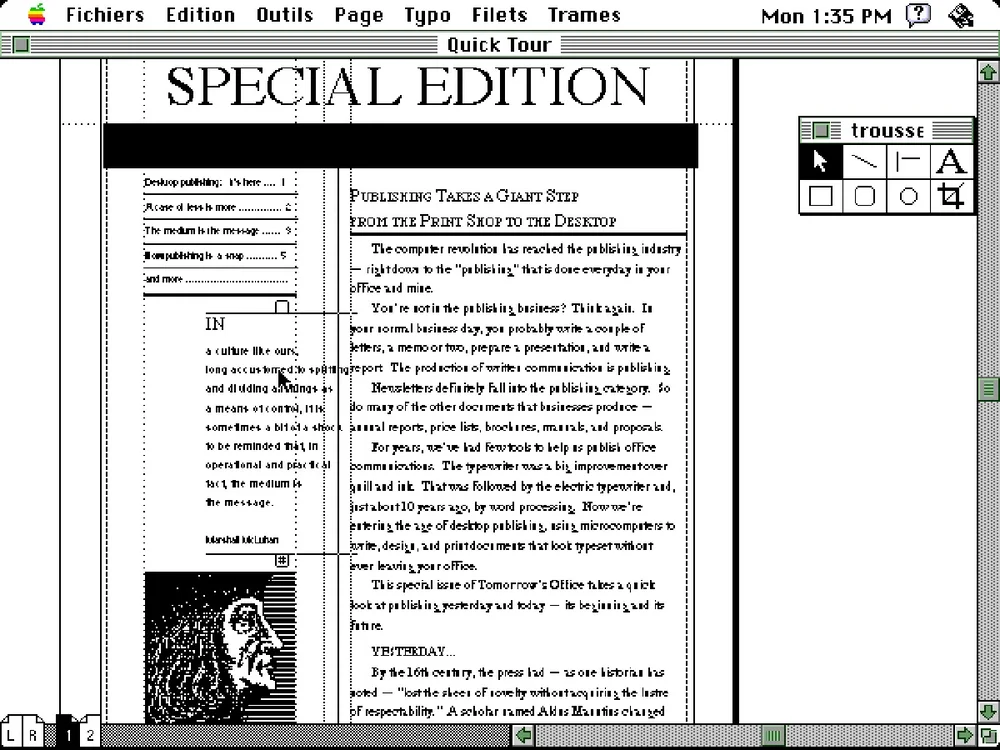
Desktop publishing on the Mac — laying out magazines in the black-and-white era.
1989 — 1991 · The Mac & the craft
Falling for the machine that had a mouse.
In 1989 I monopolised my mother's Macintosh SE/30 and fell hard for its windows, menus and mouse. I made magazines in SuperPaint and modified the hardware for fun — at one point swapping a print cartridge for an optical reading head to digitise photos and drawings. My tinkering impressed an Apple dealer, who offered me a job.
I started my career as a graphic designer at Paparazzi, a below-the-line agency, and briefly studied typography and graphic design at La Cambre. Then I computerised photoengraving companies with Scitex systems, wired them into Apple networks, and ran some of the first versions of Photoshop. Craft and code were already inseparable.
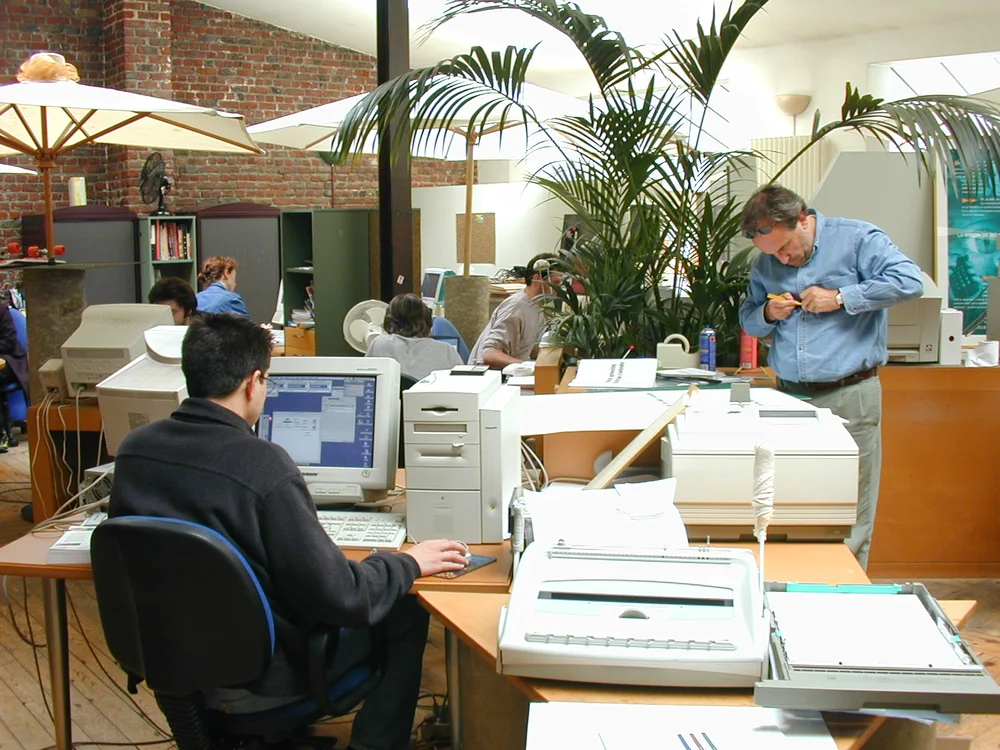
The early Ex Machina office — Macs, CRTs, and very long nights.
1991 · Ex Machina
Named in a single night.
While chasing a late invoice at Paparazzi, studio head Catherine Decarpentrie offered me something better than the cheque: build their prepress desk. That same night, I named the venture Ex Machina.
We moved from a shared office to a garage in Forest, and the first decade was gloriously intense — prepress, CD-ROMs, interactive kiosks, the first websites, early video editing. I lived on-site, next to the servers I watched over at night. In 1996 we released Le Mystère Magritte, a multimedia tribute to the painter. Clients like Belgacom, Coca-Cola, Electrabel, Apple and Swatch came knocking, and so did buyers — but I valued independence more than any offer.
I named it that same night. Then I went back to work.
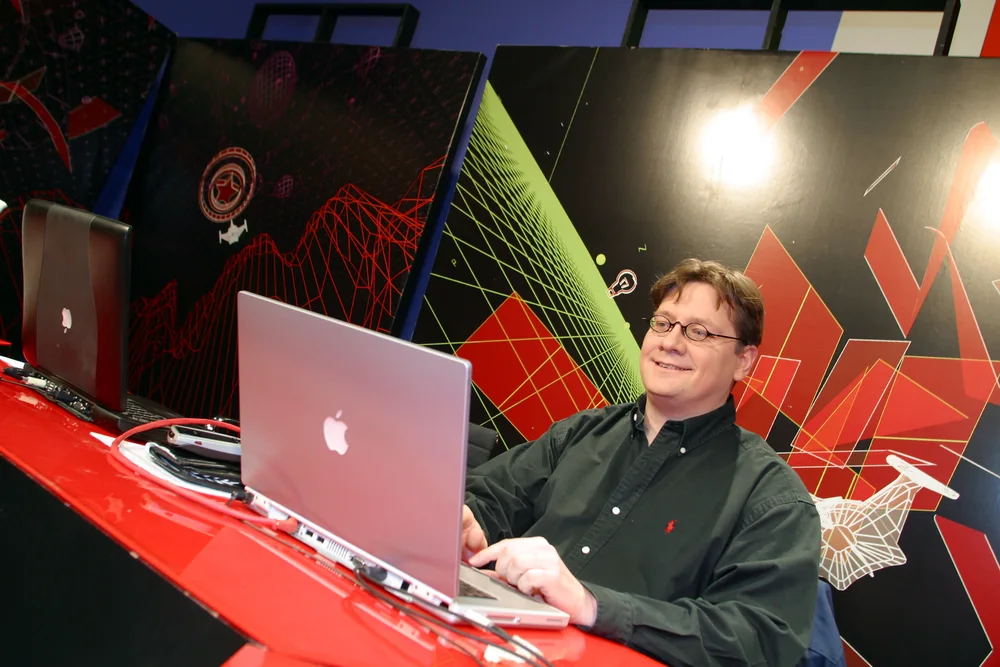
On air — translating geek culture for a general audience.
1996 — 2005 · Media mogul ;-)
CyberCafé, and how the internet met prime time.
Around the same time, I became a media figure. From 1996 to 2005 I hosted CyberCafé21 — first on Radio 21, then on the RTBF — bringing the internet and geek culture to a general audience for nearly a decade. It was produced by Ex Machina Television, and over the years it grew into a small family of formats across radio and television.
Long before "creator" was a job title, the show was a weekly invitation to a world most viewers had never logged into. For a generation of Belgian geeks, CyberCafé and its spin-offs became part of the furniture — proof that technology was culture, not just plumbing.


Bringing the internet to people who had never logged on.
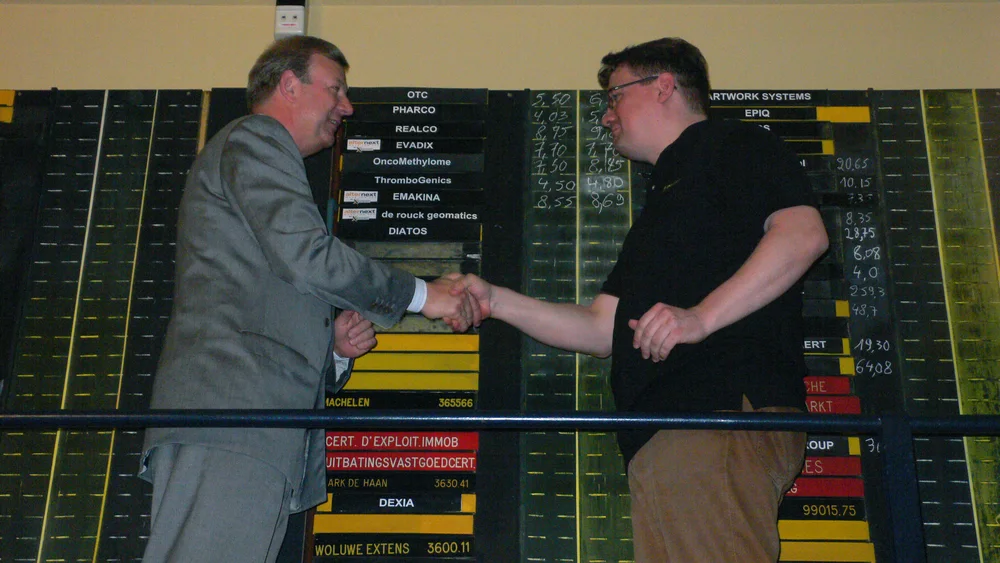
2006 — Emakina lists on Alternext Brussels.
2001 — 2021 · Emakina & The User Agency
From a garage to twenty countries.
In 1998, with Patrick De Schutter and Arnaud Huret, I co-founded ContactOffice — a private collaboration cloud with mail, documents and calendars, years before Google Workspace existed. It lives on today as Mailfence.
Then, on 1 April 2001, Ex Machina merged with Emalaya — founded by Denis Steisel, Philip Palaz and Edouard Janssens — and Emakina was born. For twenty years I led it as president and CEO around one idea: The User Agency. Strategy, technology and creativity, all placed in the service of the user. I made a habit of dragging "world firsts" into the office.
In 2006 Emakina went public on Alternext Brussels — a rarity for a digital agency — and the market's confidence funded an international expansion across Europe, Asia, the USA and Africa: more than 1,100 people, 25 offices, 20 countries. During the Covid crisis I wrote about resilience in the Belgian economic press. In 2021, after two decades of unbroken growth, Emakina was acquired by EPAM, and I became its Chief Visionary Officer.
I knew smarter people existed. The edge was using new technology creatively — with a clear plan.
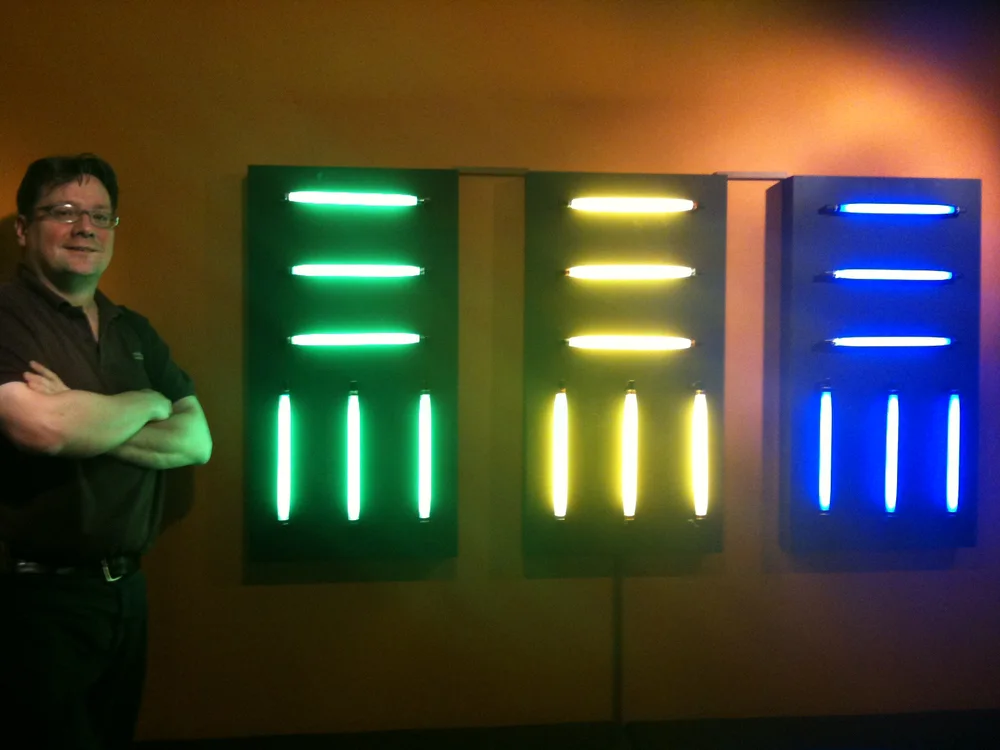
Always another idea on the bench.
2007 → · The serial entrepreneur
A constant habit of starting things.
Emakina was never the whole story. In 2007 I co-founded Tunz, a mobile SMS-payment company, and filed electronic-payment patents; it was acquired by Ogone in 2012 and folded into Ingenico in 2013. Zingle (2009) and Zin.gl (2011, $600k raised from business angels) followed.
The same year, I helped create the P2P Foundation with Michel Bauwens and James Burke. I also launched Objekten, a new generation of European design label — smart, eco-friendly, affordable objects by designers like Mathieu Lehanneur, Sylvain Willenz and Alain Berteau, made in Europe. Some of these ventures were ephemeral, some endure; together they tell a single story of relentless experimentation.
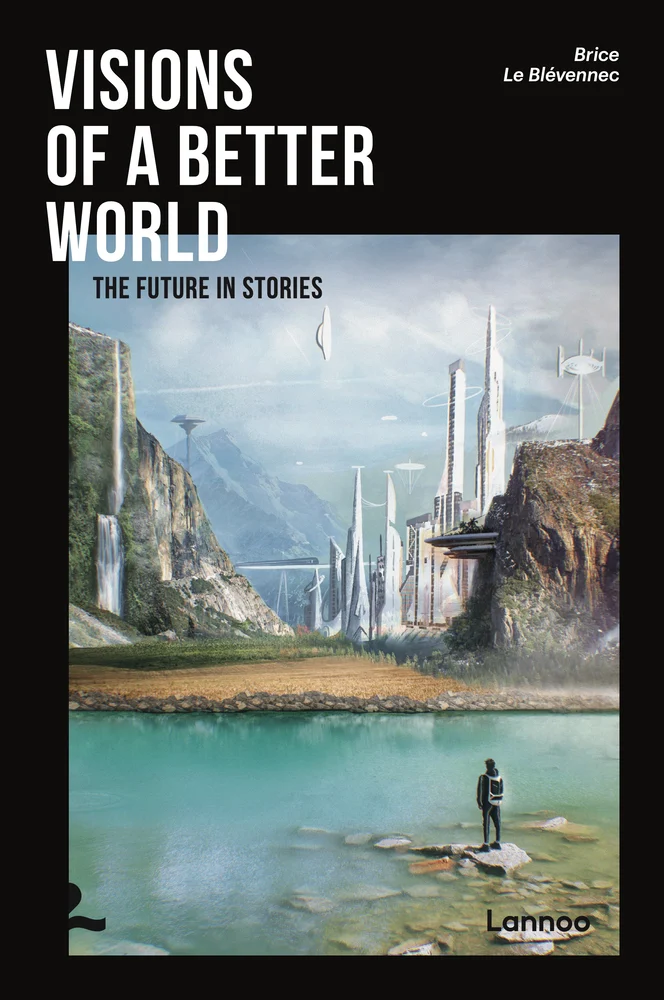
Visions of a Better World — The Future in Stories (Lannoo).
2021 · The author
Visions of a Better World.
For Ex Machina's 30th anniversary, I published Visions of a Better World — a prospective essay imagining how society might evolve by 2051, told across thirty articles. Each one opens with a short fiction, a User Experience set in the future, then steps back to the science, innovation and trends that could make it real — fully referenced.
The articles run from the highly probable to the gloriously impossible, on a scale from Science to Fiction. Written with about a dozen Emakina consultants, it's a deliberately optimistic, mobilising look at the future — a genre I call Applied Science Fiction.
Read the 30 visions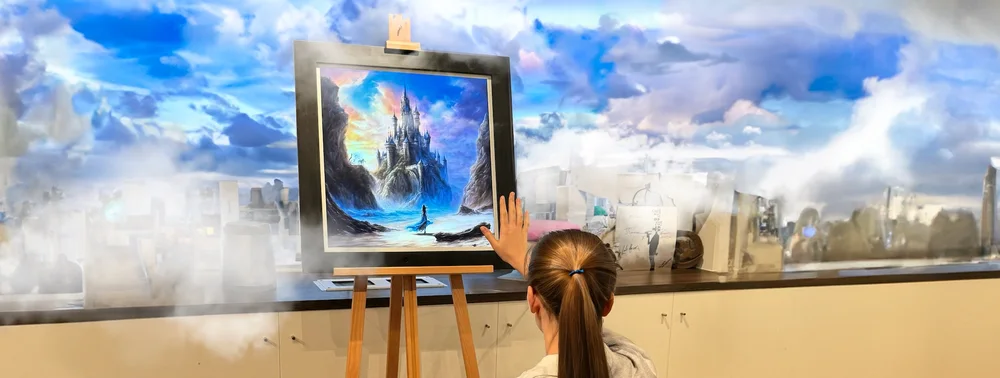
2023 — Zoetrope: frames that paint themselves.
2023 → · Still exploring
Generative art, and a few hundred bets.
In 2023 I founded Zoetrope: digital art frames that use artificial intelligence to generate and display interactive, ever-evolving artworks — art, technology and aesthetic experience in one object. It sits exactly where I've always liked to stand: at the frontier.
These days I'm also a hands-on business angel, backing founders directly and through Verve Ventures and BeAngel. Along the way the work has been kind enough to win a few distinctions — a Lifetime Achievement Award from the IAB in 2009, and a Top Agency title for Emakina at the Horizon Interactive Awards in 2014.
See the portfolio// Today
Tech trendsetter, über geek,
visionary, author.
Father of two. Hooked on music — jazz, funk, synthesisers and electronic production — a comic-book reader, a gamer since Pong, and a man who still gets through a magazine a day (with a complete Wired collection to prove it). Insatiably curious, permanently immersed in the culture of technology. Forty-five years in, the thirteen-year-old at the terminal hasn't really changed — he just has better tools.